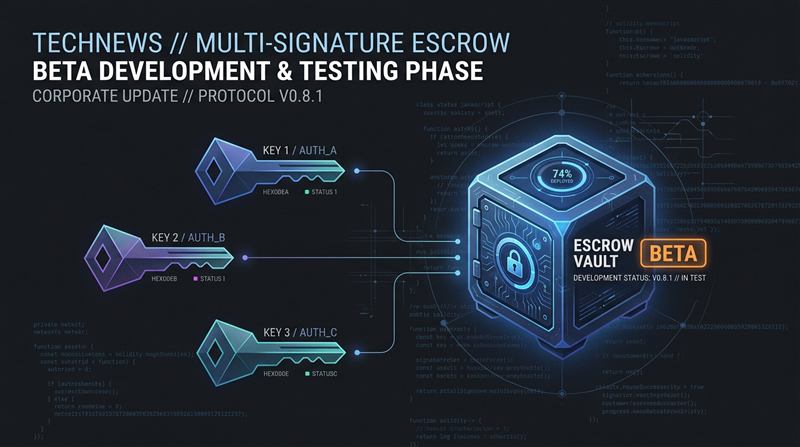
The Nexus platform is providing a detailed update on the development status of its multi-signature escrow implementation. Multi-sig escrow represents a significant architectural advancement over the current single-signature model: rather than the marketplace holding sole custody of escrowed funds, a 2-of-3 multisig arrangement distributes signing authority between the buyer, the vendor, and the marketplace. No single party can unilaterally release funds. This update covers the current development stage, testing results, and anticipated launch timeline.
Why Multi-Sig Escrow Is Technically Complex
Standard escrow requires the marketplace to generate a deposit address and hold the private key controlling it. This works but creates a single point of trust: users must trust that the marketplace will not abscond with funds and that its key storage is secure. Multi-sig escrow eliminates this single point of trust. In a 2-of-3 arrangement, the buyer holds key 1, the vendor holds key 2, and the marketplace holds key 3. Releasing funds requires any two of the three parties to sign the transaction.
In a successful trade, the buyer signs, the vendor signs, and funds are released without marketplace involvement. If a dispute arises, the marketplace acts as arbitrator: if it agrees with the buyer, it signs with key 3 to return funds; if it agrees with the vendor, it signs with key 3 to release payment. The marketplace never has unilateral access to funds at any point in the process. This architecture is considered the gold standard for trustless escrow in cryptocurrency commerce.
The complexity lies in implementation. Unlike standard transactions, multi-sig transactions must be constructed carefully, as errors in key derivation or transaction signing can result in permanently unspendable funds. The development team is using established multi-sig libraries with extensive test coverage and is conducting the implementation in stages with formal review at each milestone.
Current Development Stage and Testing
The core multisig transaction library has completed unit testing with a 100% pass rate across 2,847 test cases covering normal flow, dispute flow, and edge cases including unresponsive parties and timeout conditions. Integration with the escrow backend is in progress. The staging environment is now running the full multi-sig flow for Monero transactions, with XMR chosen as the priority implementation given its privacy guarantees. Bitcoin multi-sig is in parallel development and will follow the XMR launch.
Beta testing with a select group of high-volume vendors and trusted buyers is scheduled to begin within the next few weeks. Beta participants will use the multi-sig flow for real transactions and provide feedback on the user experience of key management and signing. The development team is particularly focused on making the signing interface accessible to users who are not cryptographically technical, while preserving the security properties of the underlying system.
What Happens at Launch
At launch, multi-sig escrow will be available as an opt-in feature. Standard escrow will remain available for users who prefer it. Vendor profiles will display whether they accept multi-sig, and buyers will be able to filter vendors by this preference. Guidance on setting up and using multi-sig escrow will be published alongside the feature launch. For current escrow and payment guidance, the FAQ covers the existing system. For background on why Monero is the recommended currency for multi-sig, see the XMR guide.